As part of CLL Global Research Foundation’s virtual town hall, Dr. Jackie Broadway-Duren responded to an audience question about CLL clinical trials. Dr. Alessandra Ferrajoli explains that clinical trial options depend on where patients are in their treatment journey and emphasizes that trials offer close monitoring and an opportunity to improve existing therapies while bringing hope for better long-term outcomes.
Expert Panel:
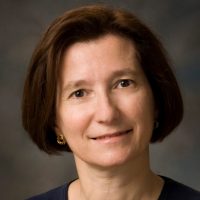
Dr. Alessandra Ferrajoli, The University of Texas MD Anderson Cancer Center

Dr. Jackie Broadway-Duren, The University of Texas MD Anderson Cancer Center
Transcript:
Dr. Alessandra Ferrajoli: I would say that all the clinical trials are showing promise right now. If you’re asking me which agents are the most exciting, we always look for the newer kids in the block. And the newer kids in the block are the BTK degraders, the new BCL-2 inhibitors, bispecific monoclonal antibody, new type of cellular therapy like CAR T, off-the-shelf CAR T
So, those are the most exciting things that we have. But, if you’re asking me what is the clinical trial that is right for you, I would say that also depends where you are in your journey. For a patient that is just now entering the need for treatment, I always recommend a Phase II or a Phase III clinical trials. Those are trials with medications that are often approved but what is investigational is how many of them are given together, with which schedule, for how long. If, instead, the patient has had many treatments before, the disease is somehow developing some changes, some resistance, then those are the people that really should be brave.
They should be brave and their doctors should be brave. And using a newer agent, a newer mechanism of action that is usually what we do in Phase I clinical trial can be very successful at times. So, again, the type of treatment, the type of clinical trial depends on where you are.
Jeff Folloder: So, I’m going to ask you to expand on that just a little bit. We’re coming towards the end of our allotted time for Q&A. You’re talking about it depends for clinical trials. Tell me more about where we are with the CLL research and what it really means for patients. I know so many people who say, “I’m not going to be a guinea pig.” Where are we?
Dr. Alessandra Ferrajoli: So, I don’t think anyone that participates in a clinical trial is a guinea pig. There are a lot of advantages from participating in clinical trials. What we try to do is improve on things that are already so good. This is why we have clinical trials with BTK inhibitors, we have clinical trials with BCL-2 inhibitors. Those have been really practice changes drugs. Now we are working out the small details of how they should be given, for how long, which one I believe the best when you give them in combination. When you participate in a clinical trial you have an entire team that monitors you, that decides how long you need to be, that looks at every small side effect.
So, we are really providing a very, very good service by offering clinical trials because we’re working on making what is already good better. And that is kind of the same thing for earlier clinical trials. We have agents that we have signals that are really going to be the next best therapy. We use clinical trials to do the test on the road. But we know there is a lot of support. We just don’t open a vial and use a chemical. There are years and years of research. There is preclinical study on cells. There are some studies on animal models that really reproduce the same conditions as CLL. Often there’ve been some studies in humans that support that what we do is safe and likely to be useful.
Jeff Folloder: I believe what I hear you saying is that even though it’s a four letter word, hope is here and hope is important.
Dr. Alessandra Ferrajoli: Yeah. If I can expand, I know we talk about cure. Dr. Broadway-Duren said cure is not there yet. However, I want to specify that I have a personal view of cure. That is if my patient with CLL can live a good life as long as they were programmed from the day they were born to live because I give them therapies that work in the same way as the therapy for blood pressure, as the therapy for diabetes, that keeps the condition under check, I think that patient should consider himself or herself cured.
Because this is what I call functional cure.
Jeff Folloder: Two four letter words.
Dr. Alessandra Ferrajoli: We have so many things that can help us to achieve that. So many agents.